The short answer
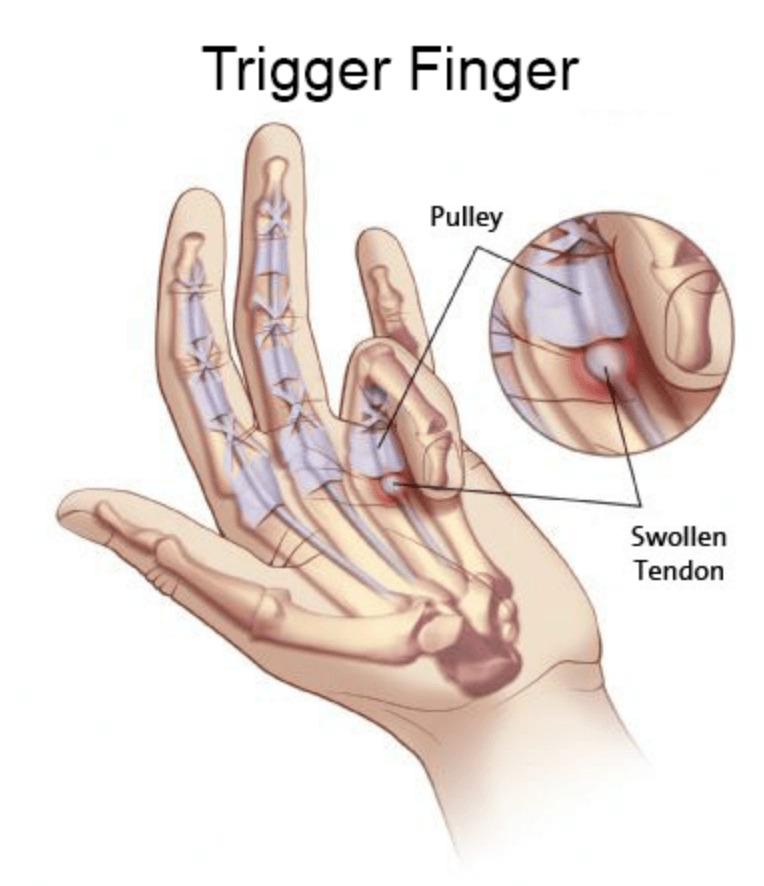
Trigger finger occurs when a flexor tendon swells and catches beneath the A1 pulley ligament, causing pain, catching, and locking when bending the finger. It often follows repetitive gripping. Treatment includes hand therapy, splinting, anti-inflammatories, and steroid injection, with an ultrasound-guided percutaneous release for cases that don't resolve.

Medically reviewed by Marc Gruner, DO, MBA, RMSK
Sports medicine physician, Mayo Clinic fellowship. Last reviewed June 2026
Overview
Trigger finger affects people who perform repetitive gripping or flexing. The tendons that bend the fingers run beneath the A1 pulley ligament; when a tendon becomes inflamed and develops a nodule, it catches under the ligament, causing pain and a locking or popping sensation — and in severe cases the finger gets stuck.
Dr. Gruner treats trigger finger with hand therapy, splinting, anti-inflammatories, and a steroid injection. When these don't resolve it, he offers a percutaneous, ultrasound-guided A1 pulley release — a needle procedure with no surgical incision, immediate finger bending, and light gripping within a few days.
Common symptoms
- Pain when bending the finger
- Catching, popping, or locking of the finger
- In severe cases, the finger gets stuck and cannot bend
Videos from Dr. Gruner
Ultrasound-Guided Trigger Finger Release — Dr. Marc Gruner
What to expect at your visit
- 1.
A focused conversation
Dr. Gruner reviews your history, prior imaging, and goals — what you want to get back to doing.
- 2.
Point-of-care ultrasound
When useful, a diagnostic musculoskeletal ultrasound evaluates the injury in real time, with no radiation.
- 3.
A clear, individualized plan
You leave understanding the diagnosis, the non-surgical options, and the expected timeline — in plain language.
Clinical evidence
Selected peer-reviewed research supporting these approaches.
Frequently asked questions
- How do I know if I have trigger finger?
- The hallmark is pain when bending the finger and a catching or locking sensation as you flex it; in severe cases tendon swelling prevents the finger from bending at all.
- What are the treatment options for trigger finger?
- Hand therapy, anti-inflammatory medication, a finger splint, and a steroid injection are first-line. For persistent cases, an ultrasound-guided percutaneous release avoids open surgery, with faster recovery and minimal scarring.