The short answer
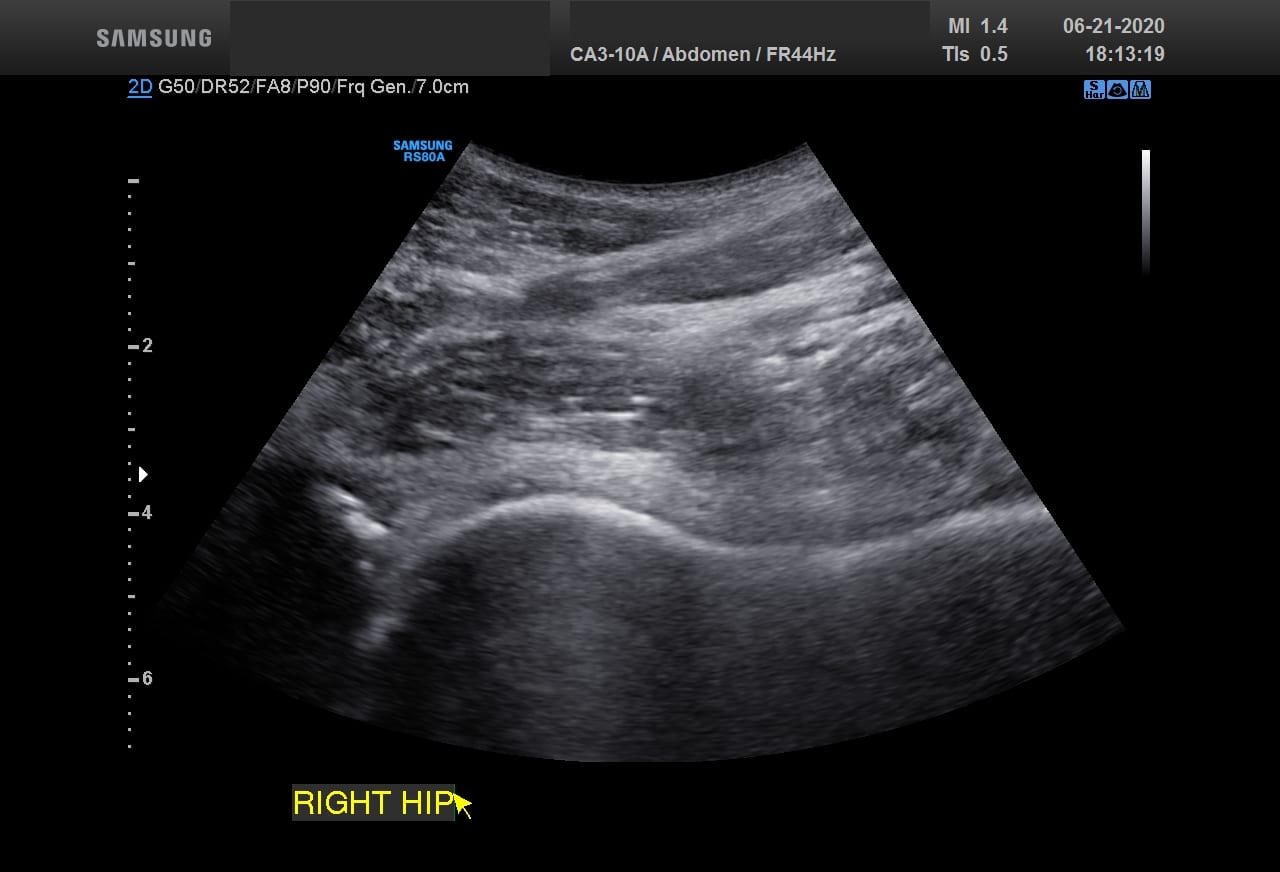
Diagnostic musculoskeletal ultrasound uses high-frequency sound waves and a handheld transducer to image tendons, ligaments, muscles, nerves, and joints in real time, with no radiation. It lets Dr. Gruner evaluate injuries dynamically, confirm a diagnosis at the point of care, and guide injections with precision — often avoiding the need for MRI.

Medically reviewed by Marc Gruner, DO, MBA, RMSK
Sports medicine physician, Mayo Clinic fellowship. Last reviewed June 2026
How it works
A transducer emits high-frequency sound waves that penetrate tissue and bounce back to create real-time images. Because ultrasound is dynamic, Dr. Gruner can move the joint and watch tendons, ligaments, and nerves as they work — something a static MRI cannot do — all without radiation.
Performed at the point of care, it shortens the path from symptom to diagnosis and makes injections far more accurate by guiding the needle to the exact target. It is high-resolution for soft tissue and cost-effective, often eliminating the need for MRI or CT.
Why patients choose it
- Real-time, dynamic soft-tissue imaging
- No radiation
- Point-of-care: diagnosis in a single visit
- Cost-effective vs. MRI/CT; guides precise injections
What to expect at your visit
- 1.
A focused conversation
Dr. Gruner reviews your history, prior imaging, and goals — what you want to get back to doing.
- 2.
Point-of-care ultrasound
When useful, a diagnostic musculoskeletal ultrasound evaluates the injury in real time, with no radiation.
- 3.
A clear, individualized plan
You leave understanding the diagnosis, the non-surgical options, and the expected timeline — in plain language.
Before and after your procedure
- Do I need to do anything to prepare for a diagnostic ultrasound?
- No special preparation is needed. Wear loose clothing that gives easy access to the area being examined. The exam is painless — a small probe with gel is moved over the skin.
- What happens after a diagnostic ultrasound?
- There's no recovery — you can resume all activity immediately. Because it's a point-of-care exam, Dr. Gruner often reviews the findings and discusses a treatment plan with you during the same visit.
Frequently asked questions
- Is ultrasound as good as an MRI?
- They're complementary. Ultrasound excels at dynamic, real-time evaluation of superficial soft tissue and guiding injections, with immediate results and no radiation; MRI is better for deep structures and bone. For many musculoskeletal problems, ultrasound is sufficient and can avoid an MRI.