The short answer
Tennis elbow is injury to the common extensor tendon on the outside of the elbow, usually from repetitive wrist extension. It causes pain and stiffness over the outer elbow, pain radiating down the arm, and trouble gripping. First-line care is activity modification, bracing, and physical therapy; persistent cases respond to ultrasound-guided PRP or percutaneous tenotomy (Tenex).

Medically reviewed by Marc Gruner, DO, MBA, RMSK
Sports medicine physician, Mayo Clinic fellowship. Last reviewed June 2026
Overview
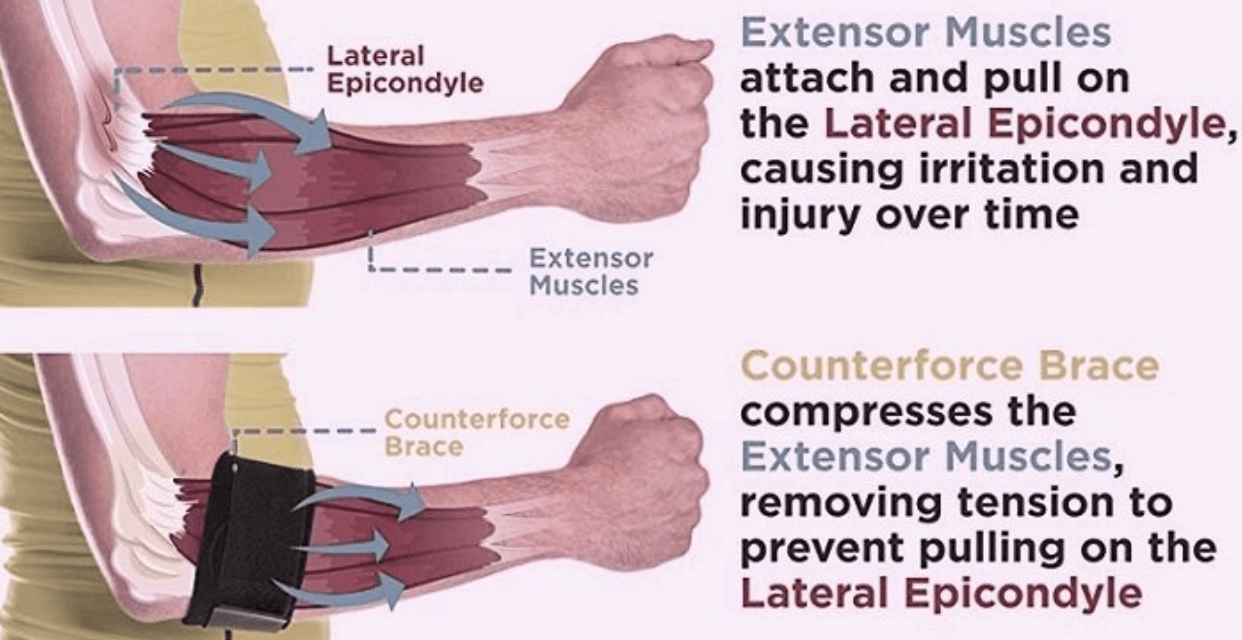
Tennis elbow (lateral epicondylitis) is a degenerative overuse injury of the common extensor tendon where it attaches on the outside of the elbow. Despite the name, it affects far more office workers and tradespeople than tennis players — anyone who repeatedly stresses these tendons through wrist extension can develop it.
First-line treatment is activity modification, a counterforce brace placed a couple of centimeters below the elbow, and physical therapy (massage, dry needling, and strengthening over 4–6 weeks). When pain persists, Dr. Gruner offers ultrasound-guided PRP to support tendon healing or percutaneous tenotomy (Tenex) to remove degenerated tissue.
Common symptoms
- Pain and stiffness over the outside of the elbow
- Pain radiating down the arm
- Difficulty gripping objects
- Weak grip strength
Videos from Dr. Gruner
Tennis Elbow Diagnosis and Treatment — Dr. Marc Gruner
Treating Tennis Elbow with a Procedure — Dr. Marc Gruner
Tennis Elbow Pain Treatment Guide — Dr. Marc Gruner
Tennis Elbow vs. Golfer's Elbow — Dr. Marc Gruner Explains
What to expect at your visit
- 1.
A focused conversation
Dr. Gruner reviews your history, prior imaging, and goals — what you want to get back to doing.
- 2.
Point-of-care ultrasound
When useful, a diagnostic musculoskeletal ultrasound evaluates the injury in real time, with no radiation.
- 3.
A clear, individualized plan
You leave understanding the diagnosis, the non-surgical options, and the expected timeline — in plain language.
Rehabilitation protocol
What to expect week by week after your procedure. Your plan is individualized; follow these alongside your physical therapist.
Elbow — Ultrasound-Guided Tenotomy / PRP Protocol
Week 0–1
Protect, reduce pain and swelling
- Sling for 3 days; no driving in sling
- May lift up to 5 lbs; rest and elevate
- Begin gentle active ROM 4×/day on day 3
- Optional blood-flow-restriction (BFR) training 2×/week
Weeks 1–2
Restore full range of motion
- May lift up to 10 lbs
- Avoid repetitive elbow/hand activity and sustained gripping
- Regain full ROM 3–5×/day
Weeks 2–4
Begin strengthening
- May lift up to 20 lbs
- Begin isometric wrist/elbow strengthening
- Week 3: add light wrist flexion/extension weight (~2 lbs)
Weeks 4–6
Build strength and function
- Progress isotonic strengthening
- Integrated strengthening (chest press, rows, hammer curls)
- Begin eccentric training
Weeks 6+
Return to sport
- Continue strengthening
- Sport-specific and progressive loading exercises
Do not use NSAIDs (ibuprofen, Aleve, aspirin) for 4 weeks, and avoid ice for the first week — both blunt the healing response. Acetaminophen (Tylenol) is fine for discomfort. Care is tailored to you; use these guidelines with your physical therapist.
Clinical evidence
Selected peer-reviewed research supporting these approaches.
- Efficacy of platelet-rich plasma for chronic tennis elbow: a double-blind, prospective, multicenter, randomized controlled trial of 230 patientsPubMed 23825183
- Ultrasonic Percutaneous Tenotomy for Recalcitrant Lateral Elbow Tendinopathy: Sustainability and Sonographic Progression at 3 YearsPubMed 26602153
- Platelet-rich plasma versus Tenex in the treatment of medial and lateral epicondylitisPubMed 30551782
Frequently asked questions
- Does PRP work for tennis elbow?
- For chronic tennis elbow that hasn't responded to bracing and therapy, ultrasound-guided PRP is one of the better-studied options and can meaningfully reduce pain and improve function over several weeks. Dr. Gruner confirms the diagnosis with ultrasound before recommending it.
- How long does tennis elbow take to heal?
- Many cases improve over 4–6 weeks of a structured loading program and activity change. Stubborn cases that linger for months are where ultrasound-guided PRP or a Tenex procedure can help.